_edited_edited%20(1).png)
How Are S Corporation Owners Taxed?

S corporations are a popular tax structure for many small businesses, but the way owners are taxed can be more complicated than simply paying tax on the money they withdraw from the company.
Understanding how salary, distributions, and pass-through business income are treated can help S corporation owners prepare accurate returns and avoid common tax reporting issues.
How Does S Corporation Taxation Work?
An S corporation generally does not pay federal income tax at the corporate level in the same way a traditional C corporation does.
Instead, the company's income, deductions, credits, and certain other tax items generally pass through to its shareholders.
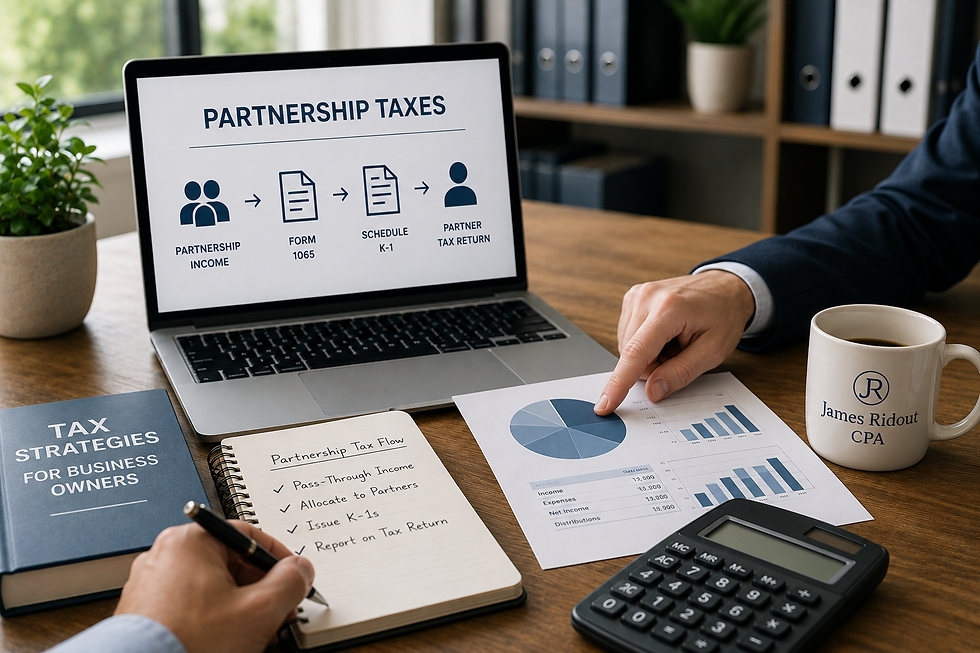
Each shareholder receives a Schedule K-1 reporting their share of the company's tax items, which are then reported on the shareholder's individual tax return.
Do S Corporation Owners Pay Tax on Business Profits?
Generally, yes.
An important concept for S corporation owners is that taxes are based on their allocated share of business income—not simply the amount of cash they withdraw from the company.
For example, an owner may owe tax on their share of S corporation income even if some of those profits remain in the business.
This makes understanding the company's financial results particularly important when planning for personal tax obligations.
How Are S Corporation Salaries Taxed?
An owner who performs services for an S corporation generally needs to receive appropriate compensation through payroll.
Salary paid to an owner-employee is generally subject to normal payroll taxes and withholding, including applicable:
Federal income tax withholding
Social Security tax
Medicare tax
Employer payroll taxes
The corporation generally reports those wages on a Form W-2.
What Is Reasonable Compensation?
The IRS requires shareholder-employees who perform services for an S corporation to receive reasonable compensation before taking non-wage distributions.
There is no single salary amount that is appropriate for every business.
Factors that may affect reasonable compensation include:
Duties and responsibilities
Experience and qualifications
Time devoted to the business
Type of work performed
Comparable industry compensation
Size and complexity of the business
Setting an artificially low salary simply to reduce payroll taxes can create tax and compliance issues.
How Are S Corporation Distributions Taxed?
After appropriate compensation is considered, an S corporation may distribute cash or property to its shareholders.
These distributions generally are not treated as wages and therefore are not ordinarily subject to employment taxes in the same way salary is.
However, that does not necessarily mean distributions are always tax-free.
The tax treatment can depend on factors including the shareholder's basis in the S corporation and the company's tax history.
What Is Shareholder Basis?
Shareholder basis is an important part of S corporation taxation.
Basis generally changes over time based on items such as:
Initial investment
Additional capital contributions
Pass-through income
Pass-through losses
Distributions
Certain other adjustments
Basis can affect whether distributions are taxable and whether an owner can currently deduct certain business losses.
Maintaining accurate basis records is therefore important for S corporation shareholders.
Can S Corporation Losses Reduce Personal Income?
Because S corporation tax items pass through to shareholders, business losses may potentially affect an owner's individual tax return.
However, several limitations can restrict whether a loss can actually be deducted in a particular year.
These may include basis limitations, at-risk rules, passive activity limitations, and other applicable tax provisions.
A business reporting a loss does not automatically mean the shareholder can deduct the entire amount against other income.
Do S Corporation Owners Pay Self-Employment Tax?
One reason business owners consider S corporation taxation is the treatment of employment taxes.
S corporation pass-through income generally is not subject to self-employment tax in the same manner as certain income from a sole proprietorship or partnership.
However, wages paid to an owner-employee remain subject to applicable payroll taxes.
This distinction is also why reasonable compensation is such an important part of S corporation compliance.
What Tax Forms Does an S Corporation File?
An S corporation generally files its own federal information return using Form 1120-S.
Shareholders then receive Schedule K-1s showing their respective shares of business tax items.
Depending on the business and its employees, additional filings may include payroll returns, W-2s, 1099s, state returns, and other required forms.
Why Tax Planning Matters for S Corporation Owners
Business and personal taxes are closely connected for an S corporation shareholder.
Decisions involving salary, distributions, retirement contributions, major purchases, and business profits can potentially affect both the company and the owner's individual tax situation.
Planning throughout the year can help business owners anticipate these consequences rather than discovering them only when the return is prepared.
S Corporation Tax Preparation With James Ridout CPA
James Ridout CPA works with S corporation owners to prepare accurate business tax returns and understand how business income, salary, distributions, and other tax items flow through to their individual returns.
Whether you already operate an S corporation or are evaluating your current business tax structure, our team can help you stay organized, meet filing requirements, and understand important tax considerations affecting your business.
This article is intended for general informational purposes and should not be considered individualized tax, legal, or financial advice. Tax treatment depends on individual circumstances and applicable tax law.


Comments